
One Door In, One Door Out
The sheriff was already talking when I got out of my car.
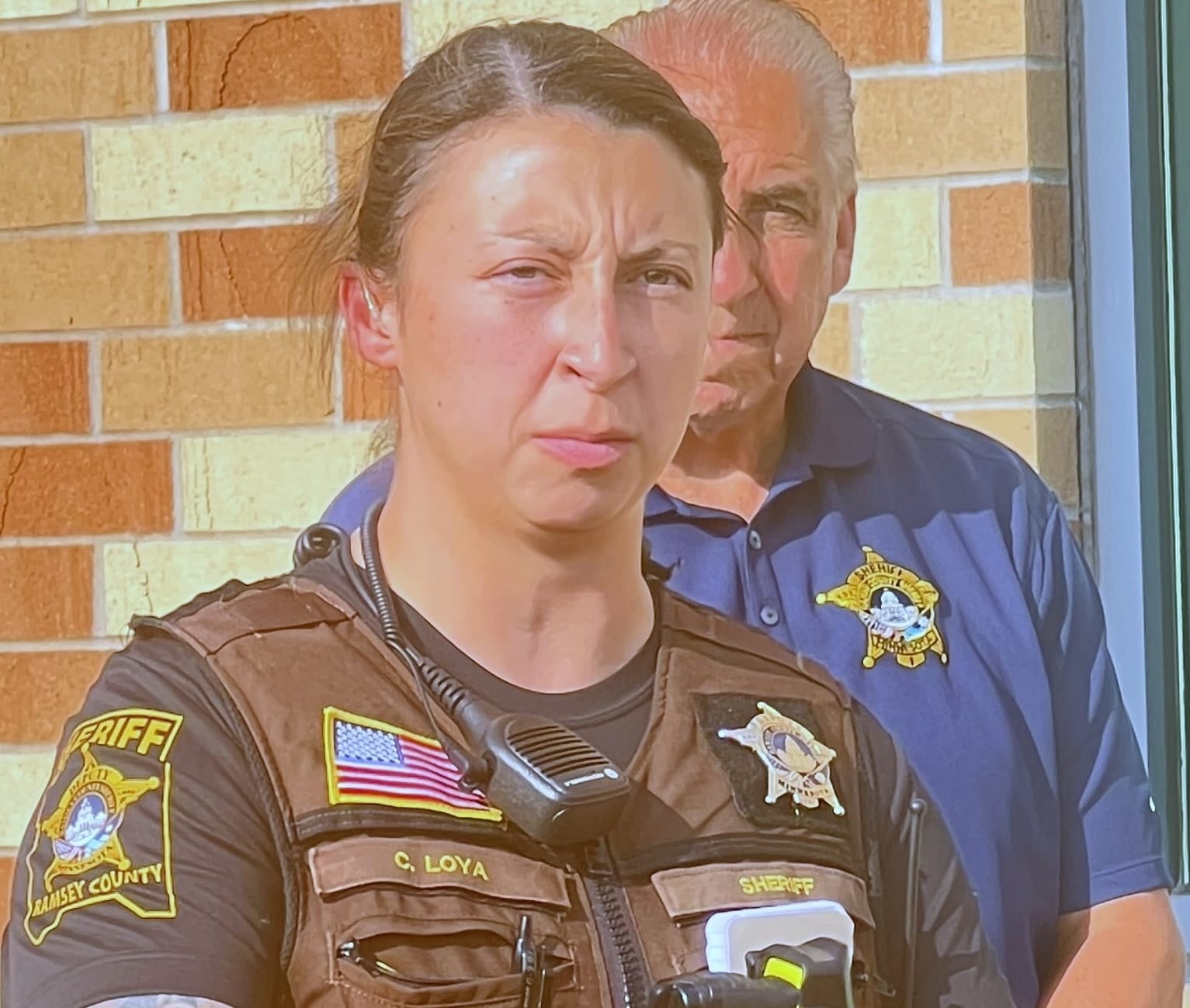
He stood in the light outside the Arden Hills patrol station, working a microphone clipped to a stand. Three deputies stood behind him like a backdrop: two men, one woman. Bob Fletcher had dressed down for the evening. A navy short-sleeved sweater. Loose pants gathered somewhere below the knee. Where the sweater had bunched up, to show a brownish belt pressed under it.
He talked with his hands. Palms up, out front, the way a man explains a family matter on his own front steps. He picked each word before he let it go.
I stood off in the entryway and let the reporters' questions wash over me. Then I asked one of my own. It was simple.
He answered it with one syllable.
No.
Inside, past the doors, there was a metal detector. Everyone crossed it. The press was left on the sidewalk, and let in later only for a few minutes, and only for sound. A camera might catch a face. A face might get a young person hurt.
A deputy stopped me and took my bag.
"It's only audio," I said. "Recording devices."
"There's no video inside."
"I only have audio recording devices."
He looked into the bag for a long moment. Then he let me pass, carrying a story in his shoulders.
About two hundred people filled the hall. Rows and rows and rows.
The room read dark on one side and pale on the other. Black and brown hijabs where the women sat. Lighter shirts and trousers where the men sat, as if the two halves had agreed on a color scheme without saying so. A few white faces mixed in. Along the back wall stood deputies in cream uniforms, hats under their arms, watching the room the way you watch weather.
On the screen were three lines.
Identify the problem. Hear from victims. Find solutions.
The room was blind and mute by design. No cameras. No microphone. If you wanted to be heard, you had to stand up, walk the aisle, and put your body at the front where everyone could see it.
By the end of the night, that would matter more than anything on the screen.
Fletcher opened for himself. He carried a stack of papers to the long table under the projector, set them down, turned to face the room, and said his own name.
Then he picked up a book with a red cover. A 1992 report on gangs in the Twin Cities, made back when he was young and the chiefs in charge still said there was no such thing here. He has been carrying some version of that book for forty years.
He told the room about Tony Bouza, the Minneapolis police chief in the 1980s, who said the city had no gangs, only kids. Fletcher said it flatly. He has been right about this for a long time, and he has stopped enjoying it.
"For those in the Somali community that are uncomfortable talking about gangs," he said, "we've had to talk about it for 40 years so we can deal with it. And it's not always fun."
Then came the calling up.
"Where's Star Wars? Come on up here for a minute while I'm talking."
Andre Robinson came forward. Gangster Disciples, Fletcher said. Moved here from Chicago in 1981, a small kid running a set. I chased him around a few years. Kept talking to him, talking to him, talking to him, until he finally figured it out.
As he said it, Fletcher's right hand came up and settled on the back of Robinson's neck. Not a grip. Not quite a hug. Then his palm came down on it. Once. Again. Again. The way a coach does it, or an uncle, or an owner.
Robinson stood there and let it happen.
"Is Meechie here too? Meechie, come on up here."
Meechie Boyd-Curry came up. Another neck. Another hand. This one had been shot, and Fletcher asked him in front of everybody how many times.
"Nine times in one shooting," Boyd-Curry said.
Both men work for the sheriff's office now, doing outreach with kids.
Then came Chy Nou Lee, who is the Ramsey County undersheriff in charge of the whole courts division, and the highest-ranking Hmong American officer in Minnesota. Fletcher met him when he was eight years old at the McDonough Homes housing project in St. Paul. Fletcher told the story of driving to Lee's parents' house with his own high school yearbook, so he could prove to them that wrestling was a decent sport for a Hmong boy. Roy Magnuson, Lee's old teacher and wrestling coach, was in the room.
People laughed. It was a good story.
It was also the argument. I have done this before, with people who look like you, and it worked.
"Every immigrant community has had one," Fletcher said. "First and second generation immigrant communities struggle with this issue."
He set the red book down, picked up the remote, and told us what the night would be.
The first picture was Fletcher himself, kneeling next to a Somali girl with henna dark on her hands.
"This is what drives the sheriff's office mission," he said. "Helping kids succeed."
Then the videos started, and the room changed temperature.
Kids at the State Fair in 2018. A good year, he said. No gang shootings. Then guns. Then more guns. He stopped on the switches, the small devices that turn a pistol into an automatic weapon, and he explained what automatic means to a room full of parents. You pull the trigger. You hold it. The magazine empties itself.
"What you're going to see here," he had warned us, "is painful."
It was. Boys in cars filming boys in cars. A shooting outside a college graduation this spring. Music laid over footage of teenagers holding weapons like props. Then screenshots pulled off social media. Threats aimed at young women. Faces the boys had not bothered to hide.
Then the scoreboard.
Someone had made one. An actual list, posted online, of what the gangs believed they had done.
"You'll see Muddy losses one, wins fifty-six," Fletcher read. "SOL, Somali Outlaws, losses two, wins forty. And you'll see the Ville down there, losses five, wins fourteen."
A win is a fight. A win is a shooting. That is the math.
"Doesn't it just seem senseless after a while when you're watching it?" he asked. "You're just like, how are we gonna convince these kids?"
He said his numbers early, and he said them again. Three hundred kids out of a hundred thousand Somalis. Fourteen murders in two years—more than a hundred shootings.
"This is not an indictment of the Somali community," he said. And: "I'm not interested in the national debate and discussion that's going on, for those of you that are here for that. We're here to help kids survive."
A hand went up.
"Has anybody in these videos been arrested that you know of?"
"No. Not that I'm aware of."
The room made a sound.
That answer became the hinge of the night—every question after it swung on that one word. A woman asked who was giving these boys guns, and whether it was even legal for them to have one. Under 18, you cannot carry, he said, and a switch is a federal crime.
Someone else asked why, then, the boys on the screen were still outside. He said the Minneapolis police are badly short of officers. He said it again a different way. He kept arriving at the same door.
That's why we need your help.
A white man called out from the back. "If you see something, say something." A small wave of clapping came up behind him.
Someone asked what a gang actually is. Fletcher gave the recipe. A shared name. Signs. Some criminal activity. Three or more people. And only one member has to commit the crime for it to belong to all of them.
To understand why the room was hot, you have to know what happened two weeks earlier.
On July 6, Fletcher went live on his own video stream and talked about a Somali gang problem. The backlash was quick. Minneapolis City Council Vice President Jamal Osman, the first Somali American to hold that seat, said the sheriff was scapegoating a whole community and called it dangerous. CAIR-Minnesota said the framing itself was dangerous. Former state Representative Hodan Hassan objected in public.
That was the weather the room walked in with. Fletcher never mentioned it.
The imam did.
Imam Hassan Jama of the Al-Hikmah Islamic Center in Minneapolis walked to the front and said he had questions before he had solutions.
"Many Somali families left hurt and singled out by your public remarks. Looking back, do you believe your choice to publicly identify the Somali community by name was appropriate?"
"Yes, I do."
"If not, would you consider apologizing to the broader Somali community —"
"No."
Fletcher came over and stood next to him.
"I am not sorry. It started the conversation, and we can't make progress unless we deal with it. And you know that I've been a friend of the Somali community for twenty years."
The imam asked if he had ever named another immigrant community this way. Yes, Fletcher said, before the question was finished. The Asian gangs. The eighties. The investigators group he helped start.
Then he turned it around.
"Do you realize there's a problem?"
"There's always problems."
"Is it a big one?"
"Yeah. It's a big one." A beat. "But let me finish."
The imam finished. He asked about drugs. Fletcher had already told us these boys had not moved into the drug trade yet, and that this was exactly why he wanted them now. Then he said something the room did not expect.
"I have four children. I lost one to an opioid overdose."
"Sorry to hear that."
"It's a very, very important issue to me."
Then the imam told him about the three men who spent forty hours working on the door of his mosque two nights before, until it gave.
"I don't want to identify them, their race or ethnicity. They committed a crime. That's your job, to look what is the motive."
And then, evenly:
"I want you to see the crime as a crime. But don't see the who's committing the crime."
He ended with the thing the whole hall was carrying, and only he would set on the table that a harsh message is coming out of Washington. That the sheriff's words are being heard as if they rhyme with it.
Fletcher did not take that one.
"Different problem."
Omar Jamal rose to answer him, and the room got hot.
Jamal is well known here. He spent years running the Somali Justice Advocacy Center. Since 2020, he has worked for the sheriff's office as a civilian community service officer. He has known Fletcher a long time, and he was not going to sit still.
"Where is the outrage of my community when there is a shooting?" he said. "How come they don't come out? When five kids are killed, nothing. Life goes on like it's business."
Then: "If you're a criminal and I call you a criminal, don't get upset with me for calling you a criminal."
"But you are not saying white criminal," someone shot back.
"You are not naming —"
"Bob Fletcher has been an outstanding law enforcement agent for more than 40 years," Jamal said. "So nobody can come and educate him what is the definition of gangs."
I stood up.
"You are not addressing the root cause of this man's concern," I said. "His concern is conflating between Somali and a gang."
Neither man answered it. Fletcher took the middle of the room instead.
"We're not gonna solve the root cause today. But we're gonna meet, and we're gonna figure out how we can help on those root causes."
Then he said something else I did not expect.
"Are racial bias — I tell you, I worked with the Hmong community. Guess what? They were more successful. You know why? Because there's more racism against Somalis, and that bothers my heart."
After that, the room came apart. Everyone talked over everyone. A white woman behind me finally stood up and shouted at the whole hall to be quiet. Let us listen to him. Everybody shut up.
Another woman turned around and told her she could not talk that way in this room; she had to be quiet too.
"I'm sorry," the first woman said, and sat down.
Somewhere in the noise, a more patient voice took the front. If everybody is quiet, we would be able to hear more. Please, audience — and then the word came out anyway, and someone said, mildly, gotta watch your language, and the sheriff said we were making progress.
The grief was on the agenda. It had a slot on the PowerPoint.
That is the hard part to write down honestly. The victims were in that room because the sheriff's office had arranged for them to be there. And the pain was real anyway. Both of those things stayed true all night.
Mahmud Kanyare came up. He and Mahdi Osman founded Youth and Family Circle, which has run a summer camp for Somali kids for more than a decade, in partnership with the sheriff's office. He had just come back from this year's camp. He asked the room to put its arguments down for a minute.
"We don't want our kids to die," he said. "We don't want our kids to end up in the graveyard. Every kid deserves an opportunity."
Deputy Jama Shine, who goes by JJ, works the same streets Ben Seidl investigates. He stood up and corrected his own title before he said anything else.
"I'm not only a police officer. I'm a parent. I'm a community member."
Then a man came forward carrying somebody else's loss.
His friend, he said, had one son. And you know what one son means in our community. The boy was killed in Burnsville. The father has since gone back to Somalia to sit with it. The two of them had spoken the day before, and the friend had sent a message into this room with him. We have to stop this. We cannot bury our kids one by one, every week, every month.
Then he laid out the shape of the killing, and the hall went quiet.
"He was killed in a closed estate. One door in, one door out. Twenty houses around. All of them have cameras. The streets have cameras. Everything has cameras."
Months later. No arrest.
"Then the gangsters feel like there's impunity," he said. "And they can go out and kill others."
Clapping came up out of the floor.
And in the hallway, before the room emptied, I talked with a mother.
She wore a veil, she said, because she is afraid of being recognized. Her son died in March. He would have turned twenty-seven yesterday. He was a father. He worked seven days a week. He had no gang, no record, no friends who did.
He had gone out for dinner. As he was getting back into his car, he was caught between two streets, and one bullet went in through his back. It opened his heart. He died there.
She said peaceful twice. She said hard-working twice.
Then she stopped saying anything about him, and started asking one thing over and over, with her eyes running.
Who did it? He must be found.
Near the end, Fletcher gave the room a clipboard and a promise. If you have a solution, come up front. Write your name down. There will be another meeting in two weeks. And next time — he said this without seeming to hear it — there will be a microphone.
"You can complain about me to the reporters, too," he told the crowd. "That's okay."
"I already did," someone said.
I found him one last time, as the chairs were scraping, and asked him the same question I had asked in the parking lot before any of it started. Do you understand the concern? The conflation. Somali and Somali gang.
"I do."
And your answer?
"It's the fastest growing gang problem that we have, and we have an opportunity to stem it right now. So I believe we have to have frank conversation. I had frank conversation with the Hmong community. I had frank conversation with the Black community in the '80s. This frank conversation is important to getting to solutions."
Then: "Most people are in denial. I know it here."
I told him that isn't the thing people are talking about.
"When you watch those videos, it breaks your heart, right?"
It does. That was never in question.
"Let's move beyond the narrative," he said, "and move to solutions."
America is a narrative, I said, if it is anything else.
He had already turned. "I gotta talk to this gentleman."
Outside, the reporters who had spent the evening on the sidewalk were still there. A Fox 9 crew had a Somali woman standing in a light, asking her to explain her community to the rest of the state.
The lot was going dark. And the sky kept getting darker.
